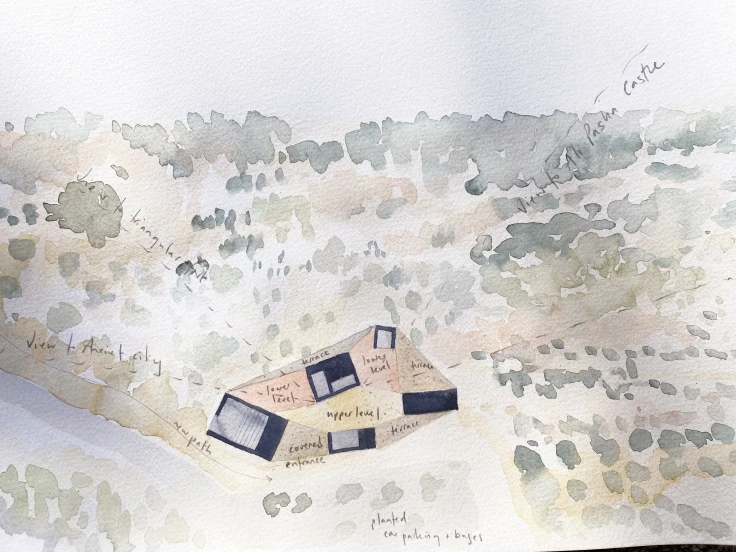
The overall architectural vision for the Belfast Stories building is inspired by the journey up to Cave Hill starting in the city and ending with a view back over the city. This is a journey that passes Belfast Castle, moves through the forests, switches back past the caves that give the hill its name, ascending a steep incline before the reward of a spectacular view back over the city and beyond. Within the Belfast Stories building we wanted to take people on a journey with the same rich variation in spatial experiences as the walk up Cave Hill, and so the architectural vision began with the conceptual idea of building as journey, and a constructed hillside in the city.
While Belfast is a city of many stories, often divisive, the one story that connects everyone is that of the geography, the topography, and a very direct visual and physical connection to landscape of the surrounding hills that contribute a very special sense of place to Belfast.
The city of Belfast is cradled by hills as described by Mary Costello in Titanic Town, 1992,
‘Belfast is beautifully situated. Surrounded by a rim of soft glaciated hills - the Black Mountain, Carrick Hill, Divis -opening out on to the lough, it lies like a puddle of cold tea in a saucer.’
Descriptions of the Belfast hills immortalised in stories both remembered and imagined in literature, poetry, diary, and memoir by a wealth of writers spanning different times and diverse backgrounds, drew us to Cave Hill as a shared and celebrated reference point in the city.
Writers such as C.S Lewis who gazed across to the hills as a boy from the other side of Belfast Lough or Jonathan Swift who immortalised the human like landscape of Cave Hill and so called ‘Sleeping Giant’ in his 1726 novel Gulliver’s Travels, were all connected by a common sense of connection to this place, a presence in the city that connects past, present and future.
Just as the hills have inspired writers, and their stories, the Belfast Hills and Cave Hill in particular has provided inspiration for the architectural narrative of this Belfast Stories proposal - imagined as a hillside journey to a view with twists and turns to be explored through the building programme and special spatial moments created along the way - orientating visitors within the building and connecting them back out to the wider city.
The conceptual diagram imagines the heaviness of the hillside and the caves accommodating the darker spaces programatically such as cinemas and exhibitions, while a lighter forest of screens wraps round the internal circulation and social spaces which will step up and weave around past planted terraces and plateaus which represent the forests and clearings on Cave Hill, before rising in to a tower like the cliff face of Cave Hill and a final light filled room at the top from where views over the city can be enjoyed.
Design Team:
Lead Architect: John McAslan and Partners
Local / Design Architect: ALWA
Landscape Architect: Simon Ronan
Consulting Engineer: ARUP
Type
competition
Location
Belfast
Status
Completed 2023